



Our Blogs
How to Measure an Outboard Motor Shaft Length Like a Pro

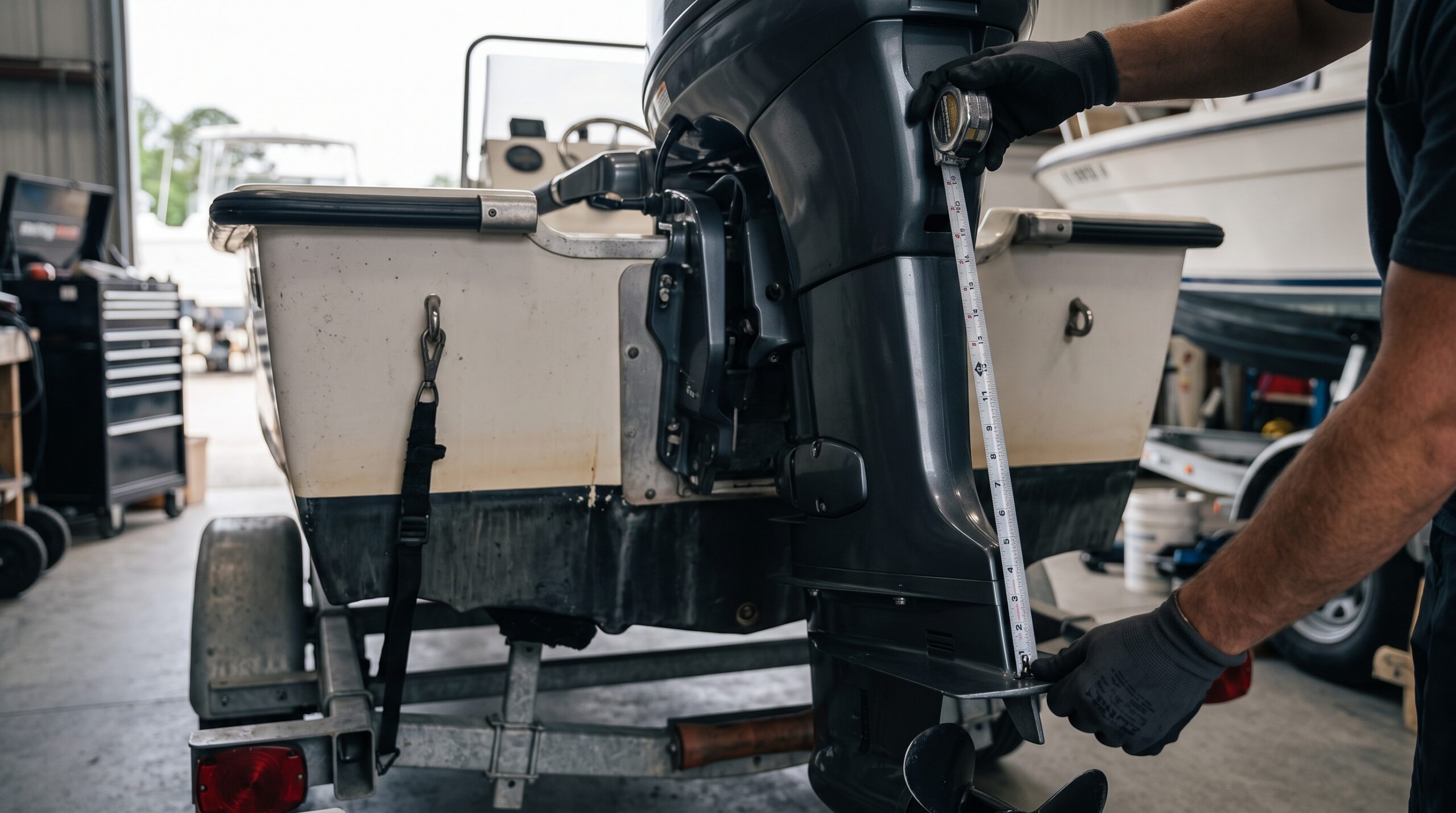
Choosing the correct outboard motor shaft length is important for your boat’s performance. If the shaft is too short, the propeller may sit too close to the water’s surface. If it is too long, the motor may sit too low in the water. Both problems can affect handling, efficiency, and overall performance.
The good news is that measuring an outboard motor shaft length is a simple process when you know which points to measure. You need a measuring tape, a straightedge, and the correct measurement points specified by the motor manufacturer.
In this guide, you will learn how to measure an outboard motor shaft length step by step. You will also learn how to measure your boat’s transom height, understand common shaft sizes, avoid measurement mistakes, and choose a motor that fits your boat.
Before buying or installing an outboard motor, always compare your measurements with the boat and motor manufacturers’ recommendations. This helps you make an informed choice and avoid problems caused by an incorrect fit.
What Is an Outboard Motor Shaft Length?
Outboard motor shaft length is a measurement used to match an outboard motor to the height of a boat’s transom. The transom is the rear section of the boat where the motor is mounted.
The shaft length helps determine how high or low the motor’s lower unit and propeller sit in relation to the boat’s hull.
When people discuss outboard shaft sizes, they commonly refer to short-shaft, long-shaft, and extra-long-shaft models. These categories usually correspond to nominal lengths of 15, 20, and 25 inches, respectively.
However, these are common categories rather than universal rules. Some manufacturers offer other sizes, and the correct mounting arrangement can vary by motor design.
Understanding Outboard Motor Shaft Length
To understand shaft length, you first need to identify the motor’s mounting bracket and anti-ventilation plate.
The mounting bracket attaches the outboard to the boat’s transom. The anti-ventilation plate is the flat, horizontal plate located above the propeller.
For many conventional outboard motors, shaft length is measured vertically from the specified mounting reference point near the top of the mounting bracket to the anti-ventilation plate. The exact reference points depend on the manufacturer and motor design.
This measurement is different from the overall height of the motor. Overall motor height includes components such as the powerhead, cowling, and other parts that do not define the nominal shaft length.
For example, an outboard with a nominal 20-inch shaft may have a much greater overall height because the engine sits above the mounting bracket.
When learning how to measure an outboard motor shaft length, focus on the manufacturer’s designated reference points rather than the full height of the engine.
Why Shaft Length Matters
The correct shaft length helps position the propeller and lower unit at an appropriate depth below the boat’s hull.
This matters for several reasons.
Propeller position: The propeller needs to operate at a suitable depth in the water. If it is positioned too high, it may draw in air or exhaust gases, causing ventilation and a loss of thrust.
Handling: An incorrectly mounted motor may affect steering response and boat control. The effects depend on the hull, motor, load, and operating conditions.
Performance: A suitable shaft length helps the motor operate in its intended mounting position. An incorrect fit can reduce thrust or make the boat harder to control.
Efficiency: When the motor is correctly matched and mounted, it can operate as intended. This does not guarantee a particular fuel saving, because efficiency also depends on propeller selection, engine condition, speed, and load.
Motor protection: The motor should be mounted according to its installation instructions. An unsuitable mounting position can expose parts of the lower unit or create other operating problems.
Correct shaft length is therefore an important part of selecting an outboard motor. It should be considered alongside engine power, boat capacity, propeller choice, and the manufacturer’s mounting instructions.
What Tools Do You Need to Measure Shaft Length?
You do not need many tools to measure an outboard motor shaft. A few basic items are usually enough.
1. Measuring Tape or Ruler
A measuring tape is useful for measuring the vertical distance between the required reference points.
Choose a tape with clear inch markings. A metric tape can also work if you record the measurement in centimeters or millimeters.
For example:
- 15 inches equals 38.1 centimeters.
- 20 inches equals 50.8 centimeters.
- 25 inches equals 63.5 centimeters.
These conversions describe common nominal shaft sizes. Your actual measurement should be checked against the manufacturer’s specifications.
2. Straightedge
A straightedge helps you identify a level reference across the mounting surface.
You can use a suitable straight, rigid edge to help locate the transom mounting line or the motor’s specified mounting reference point.
Make sure the straightedge is stable and does not damage the boat or motor.
3. Owner’s Manual or Manufacturer Specifications
The owner’s manual is one of the most useful resources for this task.
It may provide:
- The motor’s nominal shaft length.
- The recommended transom height.
- The correct mounting reference points.
- Installation height requirements.
- Special instructions for different motor models.
If you cannot find the manual, look for the official documentation for your exact make, model, and model year.
Do not assume that two motors with similar horsepower use the same shaft dimensions.
4. A Clear View of the Mounting Bracket and Lower Unit
You need to identify the motor’s mounting bracket and anti-ventilation plate clearly.
If the motor is already installed, inspect these parts from a safe position. Keep clear of the propeller and other moving parts.
If the motor is heavy or difficult to access, ask a qualified marine technician for help rather than attempting an unsafe lift or adjustment.
How to Measure an Outboard Motor Shaft Length Step by Step
The following steps explain how to measure an outboard motor shaft length accurately. Before you start, check the owner’s manual for the exact reference points used by your motor.
Step 1: Identify the Motor’s Mounting Point
Start by locating the motor’s mounting bracket.
This is the part that attaches the outboard to the boat’s transom. On many conventional outboards, the upper mounting reference is near the top of the bracket where the motor rests on the transom.
However, the exact measurement point can differ between designs.
Do not automatically measure from the top of the cowling or the highest point of the engine. These parts are not the standard reference for nominal shaft length.
If the motor is already mounted, use the installation manual to identify the correct reference point. If the motor is off the boat, place it securely in an approved support before measuring.
The goal of this step is to establish the correct starting point for your measurement.
Step 2: Find the Anti-Ventilation Plate
Next, locate the anti-ventilation plate on the lower unit.
This is the horizontal plate directly above the propeller. It helps limit air and exhaust gases from reaching the propeller from above under normal operating conditions.
The plate is sometimes mistakenly called a cavitation plate. Although the terms are often confused in everyday conversation, ventilation and cavitation describe different phenomena.
Ventilation occurs when air or exhaust gases enter the propeller blades. Cavitation involves the formation and collapse of vapor bubbles in water because of local pressure changes.
For shaft measurement, the important feature is the anti-ventilation plate itself.
Look for the flat plate extending outward above the propeller. Confirm its location using your motor’s manual if the design is unfamiliar.
Step 3: Measure the Shaft Length
Once you have identified both reference points, measure the vertical distance between them.
Follow these steps:
- Place the measuring tape at the manufacturer’s specified mounting reference point.
- Extend it vertically toward the anti-ventilation plate.
- Keep the tape straight rather than following the shape of the engine or lower unit.
- Read the distance at the reference point specified in the manual.
- Record the measurement and its unit.
For many conventional outboards, this is the distance from the mounting bracket’s designated top reference to the anti-ventilation plate.
Important: The measurement is not necessarily the distance from the very top of the transom to the bottom of the propeller. It is also not the total length of the motor.
The manufacturer’s diagram takes priority if its reference points differ from this general description.
For example, suppose your measurement is close to 20 inches and the manufacturer lists that model as a 20-inch shaft version. The measurement is consistent with a common long-shaft category, but you should still verify the model specification before making a purchase.
A measurement that is slightly different from a nominal size does not automatically mean the motor is the wrong type. Reference points, construction, and measurement technique can affect the result.
Step 4: Record and Verify Your Measurement
Write down your measurement as soon as you finish.
For example:
- Measured distance: approximately 20 inches.
- Measurement unit: inches.
- Motor make and model: record the exact details.
- Manufacturer’s listed shaft length: verify from the manual.
Then compare your result with the official specification.
If the motor has a model label or serial number, use it to find the correct documentation. Do not rely only on a seller’s description or the appearance of the motor.
If the result seems inconsistent with the listed shaft length, repeat the measurement. Check that you used the correct reference points and held the tape vertically.
If the discrepancy remains, contact the manufacturer or a qualified marine technician.
This verification step is especially important when buying a used outboard, because a seller may not know the exact shaft configuration.
Example: Measuring a 20-Inch Shaft
Imagine that you are inspecting a conventional outboard and the manual identifies a mounting reference point and the anti-ventilation plate as the measurement endpoints.
You measure the distance and get approximately 20 inches.
The manufacturer’s specification also identifies the motor as a 20-inch shaft model.
You can record the result as a nominal 20-inch shaft, then check whether the boat’s transom height falls within the motor manufacturer’s recommended range.
This final check matters because measuring the motor alone does not prove that it will fit your boat. You must consider both the motor’s shaft specification and the boat’s mounting requirements.
What Are the Standard Outboard Motor Shaft Lengths?
Outboard motors commonly come in three nominal shaft-length categories: short, long, and extra-long.
The following measurements are widely used in conventional outboard applications, but they are not universal. Always confirm the options available for your specific motor.
| Shaft category | Common nominal length | General application |
|---|---|---|
| Short shaft | 15 inches (38.1 cm) | Boats designed for a lower transom |
| Long shaft | 20 inches (50.8 cm) | Boats designed for a taller transom |
| Extra-long shaft | 25 inches (63.5 cm) | Boats requiring a greater mounting height |
Some models offer additional shaft lengths or use different measurement conventions. Sailboat outboards and specialized motors may have options that do not fit neatly into these three categories.
Short Shaft Outboard Motors
A short-shaft outboard commonly has a nominal shaft length of 15 inches.
These motors are often used on small boats designed with lower transoms. Examples may include certain small aluminum boats, dinghies, and portable boat setups.
However, not every small boat needs a short-shaft motor.
Two boats of similar size may have different transom designs. A boat’s intended motor position and the manufacturer’s recommendations are more important than its size alone.
Before choosing a short shaft, measure the boat’s transom and check the required mounting height.
Long Shaft Outboard Motors
A long-shaft outboard commonly has a nominal shaft length of 20 inches.
This category is frequently used on boats designed for taller transoms. Depending on the boat and motor specifications, examples may include some fishing boats, larger aluminum boats, and other recreational vessels.
A long-shaft motor should not be selected simply because it appears more powerful or more suitable for a larger boat. Shaft length and horsepower are separate specifications.
Check the recommended transom height for your exact motor model.
Extra-Long Shaft Outboard Motors
An extra-long-shaft outboard commonly has a nominal shaft length of 25 inches.
These motors are designed for applications that require the lower unit and propeller to sit deeper relative to the mounting point.
Some sailboats and specialized vessels may need extra-long shaft configurations. Other boat designs may require different arrangements.
The correct choice depends on the hull, transom design, motor mounting position, and manufacturer guidance.
Why Standard Sizes Are Only a Starting Point
Nominal shaft sizes help you compare outboards, but they do not replace the installation specifications.
Manufacturers may use different designs, and some models have more than one shaft option. A motor may also be supplied with an approved mounting arrangement that changes how it is installed.
When learning how to measure an outboard motor shaft length, use standard categories to understand the result, then confirm the exact measurement and recommended transom height in the official documentation.
How to Measure Your Boat’s Transom Height
Measuring the boat’s transom height is just as important as checking the motor’s shaft length. This measurement helps you determine which outboard models may fit your boat.
The transom is the rear section of the boat where the outboard is attached. Its height, shape, and mounting design affect the motor’s correct position.
Locate the Boat’s Transom
First, identify the rear wall of the boat where the outboard motor mounts.
On many boats, the transom is a vertical or slightly angled surface at the stern. The motor’s mounting bracket attaches to this area.
Look for the main mounting surface rather than a decorative edge or raised section that does not support the motor.
If the boat has a transom cutout, molded step, bracket, or unusual mounting design, check the boat manufacturer’s instructions. The correct measurement may depend on the specific mounting arrangement.
Before measuring, make sure the boat is stable and positioned safely. You should not need to enter an unstable boat or lean over an unsafe edge.
Measure the Transom Height
Follow these steps to measure your boat’s transom height:
- Locate the top of the motor’s mounting surface.
- Identify the appropriate point along the centerline of the boat.
- Measure vertically downward toward the bottom of the hull.
- Keep the measurement perpendicular to the mounting surface.
- Record the result in inches or centimeters.
For example, suppose the distance from the top of the mounting surface to the relevant bottom-of-hull reference is approximately 20 inches. That measurement may suggest a long-shaft application, but the boat and motor manuals must confirm the correct match.
Do not confuse transom height with shaft length. They are related measurements, but they describe different things.
Transom height describes the boat’s mounting geometry. Shaft length describes a dimension of the outboard motor.
Also, a transom that measures 20 inches does not automatically require every motor labeled with a 20-inch shaft. The appropriate mounting position and manufacturer’s recommendations determine the final choice.
Match Transom Height to Shaft Length
After measuring the transom, compare your result with the recommended transom-height range for the motor you are considering.
Use this process:
- Record the boat’s transom measurement.
- Find the motor’s exact model and shaft-length specification.
- Check the manufacturer’s recommended transom height.
- Review any installation requirements for mounting height and position.
- Confirm that the boat is approved for the motor’s power and weight.
If the measurements do not appear to match, do not try to solve the problem by guessing or changing the mounting position without guidance.
A qualified marine technician can help determine whether the motor is compatible with the boat and whether an approved mounting arrangement is needed.
How to Choose the Correct Outboard Motor Shaft Length
Choosing a motor requires more than measuring a single dimension. You need to consider the boat, its transom, the intended use, and the motor manufacturer’s specifications.
Consider Your Boat Type
Different boat designs have different mounting requirements.
Fishing boats: Some fishing boats use short-shaft outboards, while others need long or extra-long shafts. Hull design and transom height determine the suitable option.
Aluminum boats: Small aluminum boats often have simple transom designs, but their recommended shaft length can vary. Check the boat’s specifications before buying an outboard.
Inflatable boats: Inflatable boats may have a rigid transom or a specially designed mounting panel. Follow the manufacturer’s instructions because transom shape and mounting height can differ between models.
Sailboats: Sailboats may require longer shaft configurations because of their transom height, hull shape, and the way the boat moves in the water. Some manufacturers offer specialized sailboat outboards.
Other specialized vessels: Workboats, commercial boats, and boats with motor brackets may have unique requirements. Standard shaft-length categories may not tell the whole story.
The best choice is the shaft length recommended for your particular boat and motor combination.
Check the Motor Manufacturer’s Recommendations
Before buying an outboard, review the official documentation.
Look for these details:
- Recommended transom height.
- Available shaft-length options.
- Required mounting position.
- Maximum permitted engine power.
- Motor weight and mounting requirements.
- Approved installation adjustments, if any.
If you are buying a used motor, ask the seller for the model number and serial number. These details can help you locate the correct specifications.
Do not assume that two outboards with the same horsepower have the same shaft length. Manufacturers may offer different configurations within the same power range.
You should also confirm that the boat can safely support the motor’s weight and power. A correct shaft length alone does not guarantee compatibility.
Understand the Effects of Incorrect Shaft Length
An outboard that is too short or too long may not operate as intended.
If the shaft is too short:
The propeller and lower unit may sit too high relative to the hull. Depending on the boat and operating conditions, the propeller may ventilate more easily, especially when the boat pitches or turns.
This can cause a loss of thrust, changes in engine load, and inconsistent performance.
The motor may also be mounted outside its intended installation range.
If the shaft is too long:
The lower unit and propeller may sit too low in the water. This can increase drag and affect handling or performance.
A motor mounted too low may also expose more of the lower unit to underwater obstacles in shallow water.
The exact effects depend on the boat, motor, propeller, and mounting position. Not every incorrect fit produces the same symptoms.
If the mounting height is incorrect:
Even a motor with the correct nominal shaft length may perform poorly if it is mounted at an unsuitable height.
This is why you should check both shaft length and the manufacturer’s installation-height guidance.
Never change the mounting height based only on appearance. Use the approved installation instructions or seek help from a qualified technician.
Common Mistakes When Measuring Outboard Motor Shaft Length
A few simple mistakes can lead to the wrong purchase or an unsuitable installation. Avoid these common problems.
1. Measuring the Full Motor Height
The total height of an outboard includes the powerhead, cowling, and other components.
These parts do not define the nominal shaft length.
Always measure between the reference points specified by the manufacturer.
2. Using the Wrong Mounting Reference Point
Starting the measurement from the top of the engine or an unrelated part of the mounting bracket can produce an incorrect result.
Find the official measurement diagram before taking the measurement.
If the diagram is unclear, ask the motor manufacturer or a marine technician for clarification.
3. Confusing Shaft Length With Transom Height
These two measurements are connected, but they are not interchangeable.
Transom height describes the boat. Shaft length describes the motor.
Measure both separately and compare them using the manufacturer’s recommendations.
4. Assuming Every Outboard Follows the Same Specifications
Many conventional outboards use common nominal shaft sizes of 15, 20, and 25 inches.
However, some models use different configurations or have specialized mounting requirements.
Do not use a general chart as the only basis for choosing a motor.
5. Ignoring the Manufacturer’s Recommendations
A measurement that looks correct may still be unsuitable for a particular motor or boat.
Always check the owner’s manual, installation guide, or official technical specifications.
6. Measuring at an Angle
If you measure diagonally instead of vertically, the result may be inaccurate.
Keep the measuring tape straight and follow the correct reference points. Repeat the measurement if you are unsure of the result.
7. Buying a Used Motor Without Verifying Its Model
Used outboards may be advertised with incomplete or incorrect details.
Ask for the exact model information and confirm the shaft length using official documentation. If the motor has been modified, ask a qualified technician to check its configuration.
8. Choosing Shaft Length Based on Horsepower Alone
Horsepower describes engine output, not shaft length.
Two motors with the same horsepower may be offered with different shaft configurations. Always check both specifications before making a decision.
FAQ
How do you measure an outboard motor shaft length?
To measure an outboard motor shaft length, locate the mounting bracket’s specified reference point and the anti-ventilation plate above the propeller.
Measure the vertical distance between these points using a measuring tape. Keep the tape straight and follow the manufacturer’s measurement diagram.
Then compare your result with the motor’s official shaft-length specification. Also check the boat’s transom height before choosing or installing the motor.
What is the standard shaft length for an outboard motor?
Common nominal shaft lengths include:
- 15 inches: Short shaft.
- 20 inches: Long shaft.
- 25 inches: Extra-long shaft.
These are common sizes, not universal standards for every model. Some motors have other options, so check the manufacturer’s specifications.
How do I know if my outboard motor has a short or long shaft?
First, identify the motor’s exact make and model. Then check its owner’s manual or official specifications for the listed shaft length.
You can also measure the distance between the manufacturer’s specified mounting reference point and the anti-ventilation plate.
A nominal 15-inch shaft is commonly classified as short, while a nominal 20-inch shaft is commonly classified as long. Do not rely on the motor’s overall height or appearance alone.
Is outboard motor shaft length the same as transom height?
No. Shaft length is a motor measurement, while transom height is a boat measurement.
Shaft length helps determine the motor’s position relative to its mounting point. Transom height describes the distance between the boat’s mounting surface and the relevant hull reference.
You need both measurements to help select a suitable motor. The boat and motor manufacturers’ instructions determine the correct match.
What happens if an outboard motor shaft is too long?
A shaft that is too long for the boat may place the lower unit and propeller too deep in the water.
Depending on the installation, this can increase drag, affect handling, and reduce performance. It may also increase the risk of contact with underwater obstacles in shallow water.
Check the motor’s mounting requirements before installation. If an existing motor appears too low, ask a qualified marine technician to inspect the setup.
Can I use a long-shaft outboard on a short-transom boat?
Not automatically. A long-shaft motor may sit too low on a boat designed for a short shaft.
Some boats have manufacturer-approved brackets or mounting arrangements that allow a different configuration. However, you should not assume that a bracket or adjustment will make any motor suitable.
Check the boat’s specifications and the motor’s installation requirements before using a different shaft length.
Where can I find my outboard motor’s shaft length specifications?
You can find shaft-length specifications in several places:
- The owner’s manual.
- The official installation guide.
- The manufacturer’s product page.
- The motor’s model information and technical documents.
- An authorized dealer or qualified marine technician.
For a used motor, record the make, model, and serial number if available. Use those details to find the correct documentation rather than relying only on a seller’s description.
Can I measure shaft length while the motor is installed?
Yes, in many cases. You can measure an installed motor if you can safely access the correct reference points.
Make sure the boat and motor are stable, and keep clear of the propeller and moving parts. Do not climb into an unsafe position or attempt to lift the motor without suitable equipment.
If you cannot see the reference points clearly, consult the manual or ask a marine technician to perform the measurement.
Does the correct shaft length improve fuel efficiency?
A suitable shaft length and mounting position help the motor operate as intended. An unsuitable setup may create extra drag or interfere with propeller performance.
However, fuel efficiency also depends on engine condition, boat loading, propeller selection, speed, hull design, and operating conditions. Choosing the correct shaft length alone does not guarantee a specific fuel saving.
Conclusion
Learning how to measure an outboard motor shaft length is straightforward once you identify the correct reference points. Use a measuring tape to measure vertically from the manufacturer’s specified mounting point to the anti-ventilation plate above the propeller.
Then measure your boat’s transom height and compare both measurements with the boat and motor manufacturers’ recommendations.
Common shaft sizes include 15-inch short shafts, 20-inch long shafts, and 25-inch extra-long shafts, but the correct option depends on your particular setup.













One thought on “How to Measure an Outboard Motor Shaft Length Like a Pro”